
CHINA
 Hello
adventurers! And welcome to another of our journeys, today we’ve arrived to
China. China is one of Asia’s biggest countries and normally the most known,
yet not many people are familiar with the culture and customs that this
marvelous country has to offer.
Hello
adventurers! And welcome to another of our journeys, today we’ve arrived to
China. China is one of Asia’s biggest countries and normally the most known,
yet not many people are familiar with the culture and customs that this
marvelous country has to offer.
Second stop: China
 More than 1
billion people live in China, according to the Asia Society, representing 56
ethnic minority groups. The largest group is the Han Chinese, with about 900
million people. Other groups include the Tibetans, the Mongols, the Manchus,
the Naxi, and the Hezhen, which is smallest group, with fewer than 2,000
people.
More than 1
billion people live in China, according to the Asia Society, representing 56
ethnic minority groups. The largest group is the Han Chinese, with about 900
million people. Other groups include the Tibetans, the Mongols, the Manchus,
the Naxi, and the Hezhen, which is smallest group, with fewer than 2,000
people.
"Significantly,
individuals within communities create their own culture," said Cristina De
Rossi, an anthropologist at Barnet and Southgate College in London. Culture
includes religion, food, style, language, marriage, music, morals and many
other things that make up how a group acts and interacts.
HISTORY
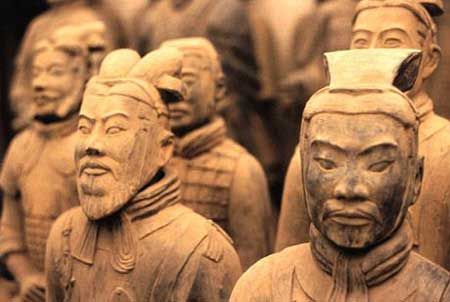 Now as
every country, to be able to have a more global view and understand the depth
of this culture, grab on tight to your seats because you guessed it, we are taking
a dip in the past…
Now as
every country, to be able to have a more global view and understand the depth
of this culture, grab on tight to your seats because you guessed it, we are taking
a dip in the past…
As we all
know, or may not know, China’s history is very vast, the base of today’s
society depends totally in the actions of the past, the characters (language
which we will review in depth further) all descend of pictures or simple
drawings that represent actions, and when combined we get different words etc.
After
10,000 BC people in China lived by hunting and gathering plants. Then, about
5,000 BC, the Chinese began farming. From about 5,000 BC rice was cultivated in
southern China and millet was grown in the north. By 5,000 BC dogs and pigs
were domesticated. By 3,000 BC sheep and (in the south) cattle were
domesticated. Finally horses were introduced into China between 3,000 and 2,300
BC. The Shang were polytheists (they worshiped many gods). The most important
god was called Di. Furthermore during the Shang dynasty in China the practice
of ancestor worship began. Ancestor worship is the belief that the dead can
intervene in the affairs of the living. Offerings were made to them to keep
them happy. Ancestor worship became part of Chinese culture for thousands of
years.
Zhou
Society
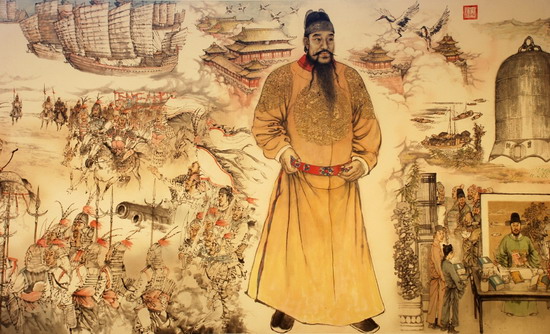 The dynasty
ruled China from about C. 1022 BC to 221 BC. The first part of the Zhou era
from C. 1022 BC to 771 BC is called the Western Zhou (because the rulers had
their capital in the west of China). The second part of the era, from 770 to
476 BC is called the Spring and Autumn period. The lastDuring the Zhou period
in China there was a class of officials who advised kings and rulers on the
right way to behave and also how to carry out rituals. The most important of
these was Kong-Fuzi (known in the West as Confucius). During his lifetime the
old feudal social and political order was breaking down. Appalled by this state
of affairs Kong-Fuzi tried to restore ancient principles. part of the era from
476 to 221 BC is called the Warring States period.
The dynasty
ruled China from about C. 1022 BC to 221 BC. The first part of the Zhou era
from C. 1022 BC to 771 BC is called the Western Zhou (because the rulers had
their capital in the west of China). The second part of the era, from 770 to
476 BC is called the Spring and Autumn period. The lastDuring the Zhou period
in China there was a class of officials who advised kings and rulers on the
right way to behave and also how to carry out rituals. The most important of
these was Kong-Fuzi (known in the West as Confucius). During his lifetime the
old feudal social and political order was breaking down. Appalled by this state
of affairs Kong-Fuzi tried to restore ancient principles. part of the era from
476 to 221 BC is called the Warring States period.
Ancient
Chinese Beliefs
The Zhou
period is sometimes called China's formative period because so much of Chinese
philosophy developed at that time. The Chinese form of divination called I
Ching was probably developed during the early part of the Zhou era. The idea of
Yin and Yang also appeared during the Zhou dynasty. The ancient Chinese
believed that all matter is made of 2 opposite and complimentary principles.
Yin is feminine, soft, gentle, dark, receptive, yielding and wet. Yang is
masculine, bright, hard, hot, active, dry and aggressive. Everything is a
mixture of these 2 opposites. The ancient Chinese also believed there were 5
elements, wood, fire, earth, metal and water. During the Zhou period the
Chinese art of acupuncture was invented.
As we can
observe china has had many dynasties throughout its history, thus forming the
extensive language that it is today. But let us skip forward in time until the Chinese
revolution.

In 1966 to
reassert his authority Mao launched the Cultural Revolution. Students began to
call themselves the Red Guard and they held rallies in Beijing. Soon a movement
began to root out old habits, beliefs and attitudes and cause a cultural
revolution. The Red Guard began to attack intellectuals and also officials. In
1967 they forced the mayor and other officials in Shanghai to resign. The same
thing happened in other cities as well. Many party officials were purged and
removed from power.
During the
Cultural Revolution religion was persecuted in China. Many places of worship
were destroyed. (Mao like all Marxists was an atheist and he detested religion).
RELIGION
Now as we’ve
seen in our previous post these countries (China and Japan) part from the same heritage
and roots, meaning that their historical context has influenced (like in any
other country) their beliefs, practices and lifestyle. As we have seen in the
last part of our historical travel, the revolution in China led to many not
only political but also religious uprising, clashing with the values that are
so characterized in Asian cultures.
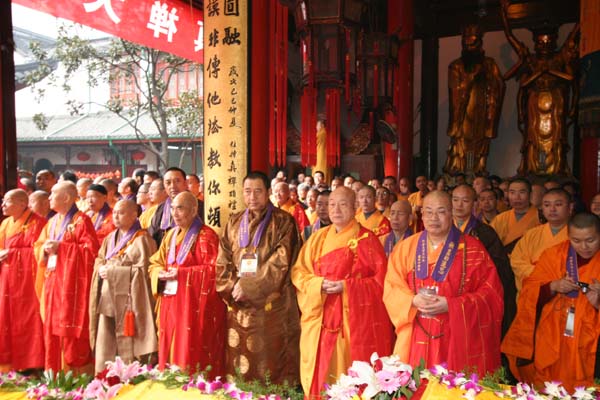 The Chinese
Communist Party that rules the nation is officially atheist, though it is
gradually becoming more tolerant of religions, according to the Council on
Foreign Relations. Currently, there are only five official religions. Any
religion other than Buddhism, Taoism, Islam, Catholicism and Protestantism are
illegal, even though the Chinese constitution states that people are allowed
freedom of religion. The gradual tolerance of religion has only started to progress
in the past few decades.
The Chinese
Communist Party that rules the nation is officially atheist, though it is
gradually becoming more tolerant of religions, according to the Council on
Foreign Relations. Currently, there are only five official religions. Any
religion other than Buddhism, Taoism, Islam, Catholicism and Protestantism are
illegal, even though the Chinese constitution states that people are allowed
freedom of religion. The gradual tolerance of religion has only started to progress
in the past few decades.
About a
quarter of the people practice Taoism and Confucianism and other traditional
religions. There are also small numbers of Buddhists, Muslims and Christians.
Although numerous Protestant and Catholic ministries have been active in the
country since the early 19th century, they have made little progress in
converting Chinese to these religions.
LANGUAGE
 Taking on
the subject that I had briefly talked about earlier here is a more detailed and
accurate history and development of language in china.
Taking on
the subject that I had briefly talked about earlier here is a more detailed and
accurate history and development of language in china.
There are
seven major groups of dialects of the Chinese language, which each have their
own variations, according to Mount Holyoke College. Mandarin dialects are
spoken by 71.5 percent of the population, followed by Wu (8.5 percent), Yue
(also called Cantonese; 5 percent), Xiang (4.8 percent), Min (4.1 percent),
Hakka (3.7 percent) and Gan (2.4 percent).
 Chinese
dialects are very different, according to Jerry Norman, a former professor of
linguistics at the University of Washington and author of "Chinese
(Cambridge Language Surveys)" (Cambridge University Press, 1988).
"Chinese is rather more like a language family than a single language made
up of a number of regional forms," he wrote. "The Chinese dialectal
complex is in many ways analogous to the Romance language family in Europe. To
take an extreme example, there is probably as much difference between the
dialects of Peking [Beijing] and Chaozhou as there is between Italian and
French."
Chinese
dialects are very different, according to Jerry Norman, a former professor of
linguistics at the University of Washington and author of "Chinese
(Cambridge Language Surveys)" (Cambridge University Press, 1988).
"Chinese is rather more like a language family than a single language made
up of a number of regional forms," he wrote. "The Chinese dialectal
complex is in many ways analogous to the Romance language family in Europe. To
take an extreme example, there is probably as much difference between the
dialects of Peking [Beijing] and Chaozhou as there is between Italian and
French."
The
official national language of China is Pŭtōnghuà, a type of Mandarin spoken in
the capital Beijing, according to the Order of the President of the People's
Republic of China. Many Chinese are also fluent in English.
 As someone
who is actively studying and practicing their Chinese, I can assure you that it
is a relatively easy language, it is only complex because the structure can be
totally different from ours. For someone who is used to see the same a, b, c, d
etc. characters over and over again repeatedly over the most common languages,
and with very little exception or little room for variation, coming in contact
with more than 3,000 characters that are all totally different and have certain
precision can become more than a challenge at first.
As someone
who is actively studying and practicing their Chinese, I can assure you that it
is a relatively easy language, it is only complex because the structure can be
totally different from ours. For someone who is used to see the same a, b, c, d
etc. characters over and over again repeatedly over the most common languages,
and with very little exception or little room for variation, coming in contact
with more than 3,000 characters that are all totally different and have certain
precision can become more than a challenge at first.
FOOD
Like other
aspects of Chinese life, cuisine is heavily influenced by geography and ethnic
diversity. Among the main styles of Chinese cooking are Cantonese, which
features stir-fried dishes, and Szechuan, which relies heavily on use of
peanuts, sesame paste and ginger and is known for its spiciness.
 Rice is not
only a major food source in China; it is also a major element that helped grow
their society, according to "Pathways to Asian Civilizations: Tracing the
Origins and Spread of Rice and Rice Cultures," an 2011 article in the
journal Rice by Dorian Q. Fuller. The Chinese word for rice is fan, which also
means "meal," and it is a staple of their diet, as are bean sprouts,
cabbage and scallions. Because they do not consume a lot of meat — occasionally
pork or chicken — tofu is a main source of protein for the Chinese.
Rice is not
only a major food source in China; it is also a major element that helped grow
their society, according to "Pathways to Asian Civilizations: Tracing the
Origins and Spread of Rice and Rice Cultures," an 2011 article in the
journal Rice by Dorian Q. Fuller. The Chinese word for rice is fan, which also
means "meal," and it is a staple of their diet, as are bean sprouts,
cabbage and scallions. Because they do not consume a lot of meat — occasionally
pork or chicken — tofu is a main source of protein for the Chinese. THE ARTS
Chinese art
is greatly influenced by the country’s rich spiritual and mystical history.
Many sculptures and paintings depict spiritual figures of Buddhism, according
to the Metropolitan Museum of Art.
Many
musical instruments are integral to Chinese culture, including the flute-like
xun and the guqin, which is in the zither family.
Eastern-style
martial arts were also developed in China, and it is the birthplace of kung fu.
This fighting technique is based on animal movements and was created in the
mid-1600s, according to Black Belt Magazine.
Ancient
Chinese were avid writers and philosophers — especially during the Ming and
Qing dynasties — and that is reflected in the country’s rich liturgical
history.
CUSTOMS AND
CELEBRATIONS
One of the
main attractions of China are the year round festivities, these attract many people
from all around the world, and no wonder why. They are most certainly one of a
kind. But why wait a year round when we can grab a ticket and go through all of
them in a row! Let’s go!
Famous
Ethnic Festivals in China
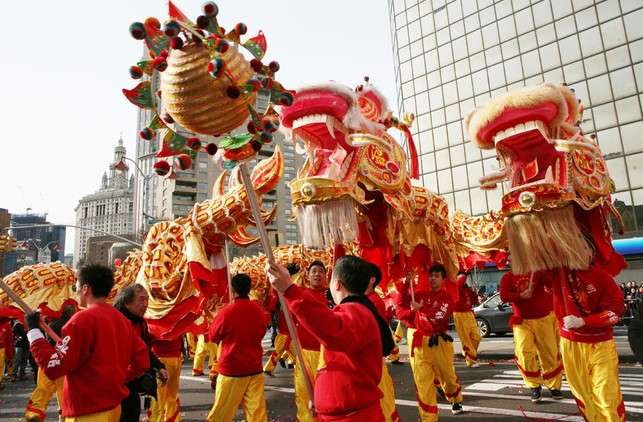 Festivals
seem to fill the yearly calendar. The following are some of the most important
ethnic festivals in China. We’ve also designed several Chinese Festivals Tours
that take you to celebrate the festivals as local people do.
Festivals
seem to fill the yearly calendar. The following are some of the most important
ethnic festivals in China. We’ve also designed several Chinese Festivals Tours
that take you to celebrate the festivals as local people do.
The largest
festival — also called the Spring Festival — marks the beginning of the Lunar
New Year. It falls between mid-January and mid-February and is a time to honor
ancestors. During the 15-day celebration, the Chinese do something every day to
welcome the new year, such as eat rice congee and mustard greens to cleanse the
body, according to the University of Victoria. The holiday is marked with
fireworks and parades featuring dancers dressed as dragons.
Many people
make pilgrimages to Confucius' birthplace in Shandong Province on his birthday,
Sept. 28. The birthday of Guanyin, the goddess of mercy, is observed by
visiting Taoist temples. It falls between late March and late April. Similar
celebrations mark the birthday of Mazu, the goddess of the sea (also known as
Tianhou), in May or June. The Moon Festival is celebrated in September or
October with fireworks, paper lanterns and moon gazing.
 New Year of
the Miao Ethnic Group
New Year of
the Miao Ethnic Group
It is the
most important festival for the Miao people. It marks the beginning of a new
year. Actually the exact dates vary each year and in different regions, and are
only disclosed one or two months in advance. The celebration in Leishan County,
Kaili City of Guizhou Province is the grandest one. During the event tourists
can enjoy watching enchanting Miao customs come alive through various kinds of
ethnic activities.
Shoton
Festival of the Tibetan People
_cp_300x225.JPG)
Shoton
Festival is one of the most popular traditional festivals in Tibet. It
celebrates eating yogurt, the Tibetan monks who end their season of meditation,
the watching of Tibetan dramatic operas, and Tibetan Buddhism. It is held
annually in the month of August, or late in the sixth month or early in the
seventh month of the Tibetan calendar. The festival is a great occasion for
both Tibetans and tourists. On the first day of the festival, the Thangka is
scheduled to be unveiled at the Drepung Monastery. Then the celebrations will
begin at Norbulingka. The residents of Lhasa will gather in the park and
celebrate by eating yoghurt and watching the operas.
New Year
Festival of the Tibetan People
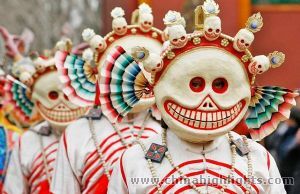 The Tibetan
New year, also known as Losar, is the most important festival in the Tibetan
calendar. It is celebrated over a period of 2 weeks. It is marked with ancient
ceremonies that represents the struggle between good and evil, by chanting, and
by passing fire torches through the crowds. A certain amount of levity is
provided by events such as the dance of the deer and the amusing battles
between the King and his various ministers. On New Year's Day, Tibetans get up
early, and put on new clothes after having taken a bath. They then worship the
gods by placing offerings in the front of their household shrines. In addition,
this day is for family members to exchange gifts. Families also have a reunion
dinner, which usually consists of a kind of cake called Kapse and an alcoholic
drink called chang, which is consumed to keep warm.
The Tibetan
New year, also known as Losar, is the most important festival in the Tibetan
calendar. It is celebrated over a period of 2 weeks. It is marked with ancient
ceremonies that represents the struggle between good and evil, by chanting, and
by passing fire torches through the crowds. A certain amount of levity is
provided by events such as the dance of the deer and the amusing battles
between the King and his various ministers. On New Year's Day, Tibetans get up
early, and put on new clothes after having taken a bath. They then worship the
gods by placing offerings in the front of their household shrines. In addition,
this day is for family members to exchange gifts. Families also have a reunion
dinner, which usually consists of a kind of cake called Kapse and an alcoholic
drink called chang, which is consumed to keep warm.
Water
Splashing Festival of the Dai Ethnic People

It is the
most important festival observed by the Dai ethnic people of Xishuangbanna
Prefecture, and, similar to neighboring Thailand's Songkran Festival, it
involves three days of celebrations that include sincere, yet light-hearted religious
rituals that invariably end in merrymaking, where everyone ends up getting
splashed, sprayed or doused with water. The Water Splashing ceremony is more
than just good-natured fun; it also contains a religious element: water is
regarded by the Dai as a symbol, firstly, of religious purity, but also of
goodwill among people. Therefore, splashing a fellow human being with water
during the Water Splashing Festival, whether a close neighbor or a fellow
villager, or even a stranger, is an expression of the desire for good luck and
prosperity to that person.
Sisters’
Meal Festival of the Miao Ethnic People
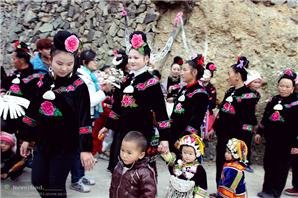 It is
regard ed as the oldest Asian Valentine's Day. A few days before the Festival,
Miao girls collect special wild flowers and leaves in the mountains to produce
natural color to dye the glutinous rice, known as "sisters' rice". At
festival time, the Miao girls, all dressed up in their holiday best with
startling silver headdresses, crowns, and neck rinks gather together by the
river banks to prepare their "sisters' rice". The rice is dyed blue,
pink, yellow, and white to represent spring, summer, autumn and winter
respectively. When the young men arrive they begin to single out the women they
hope to marry someday and begin to sing for them. The young women respond to
their songs by giving them a drink of rice wine and the sisters' rice wrapped
in handkerchiefs with different symbols on them.
It is
regard ed as the oldest Asian Valentine's Day. A few days before the Festival,
Miao girls collect special wild flowers and leaves in the mountains to produce
natural color to dye the glutinous rice, known as "sisters' rice". At
festival time, the Miao girls, all dressed up in their holiday best with
startling silver headdresses, crowns, and neck rinks gather together by the
river banks to prepare their "sisters' rice". The rice is dyed blue,
pink, yellow, and white to represent spring, summer, autumn and winter
respectively. When the young men arrive they begin to single out the women they
hope to marry someday and begin to sing for them. The young women respond to
their songs by giving them a drink of rice wine and the sisters' rice wrapped
in handkerchiefs with different symbols on them.
Naadam
Grassland Festival of the Mongolian People
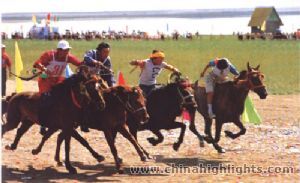 The Naadam
Grassland festival is a magnificent event featuring traditional Mongolian mass
recreational and sports activities. Naadam means games in Mongolian. It is held
between summer and autumn from July to August when the flowers are blooming,
the grass is green, and the cattle and sheep are well-fed. Tourists can
participate in and watch horseracing, wrestling and archery, and enjoy the
singing and dancing performed by Mongolian artists, or try local Mongolian
traditional foods.
The Naadam
Grassland festival is a magnificent event featuring traditional Mongolian mass
recreational and sports activities. Naadam means games in Mongolian. It is held
between summer and autumn from July to August when the flowers are blooming,
the grass is green, and the cattle and sheep are well-fed. Tourists can
participate in and watch horseracing, wrestling and archery, and enjoy the
singing and dancing performed by Mongolian artists, or try local Mongolian
traditional foods.
Lusheng
Festival
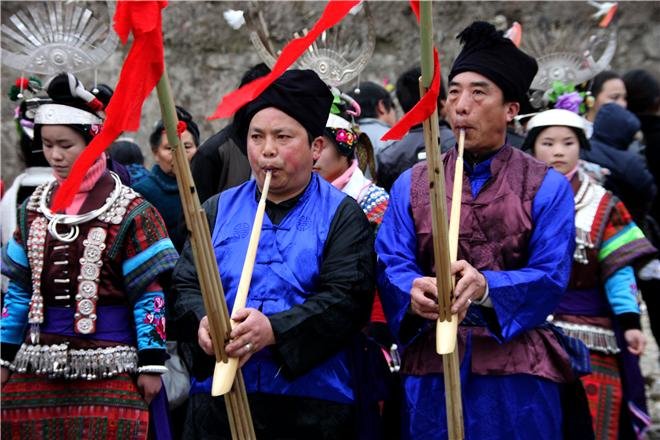 It is
popular throughout Guizhou, Yunnan, and Sichuan Provinces. The Lusheng Festival
in Kaili, Guizhou is the most famous and grandest of the bunch. The festival
features a lot of Miao ethnic activities, such as singing, bullfighting,
horseracing, and dancing to the rhythm of the Lusheng. All the Miao people come
together from different villages. The girls dress up in their best traditional
costume and silver headdresses, while the boys carry their lusheng and head to
the Lusheng Stadium to celebrate the festival. They circle in rings as the
girls dance to the rhythm of the music provided by the boys. The ceremony is
performed to bring hope for a favorable harvest in the coming year alongside
good health. It is also a chance for the youth to express their admiration and
love towards one another.
It is
popular throughout Guizhou, Yunnan, and Sichuan Provinces. The Lusheng Festival
in Kaili, Guizhou is the most famous and grandest of the bunch. The festival
features a lot of Miao ethnic activities, such as singing, bullfighting,
horseracing, and dancing to the rhythm of the Lusheng. All the Miao people come
together from different villages. The girls dress up in their best traditional
costume and silver headdresses, while the boys carry their lusheng and head to
the Lusheng Stadium to celebrate the festival. They circle in rings as the
girls dance to the rhythm of the music provided by the boys. The ceremony is
performed to bring hope for a favorable harvest in the coming year alongside
good health. It is also a chance for the youth to express their admiration and
love towards one another.
 And with
this we conclude our visit to China; I hope you’ve all enjoyed this amazing
visit to China. Today we have learned about the different Chinese dynasty and
historical patterns that have shaped and given China its character and
language. But before we conclude our amazing voyage we still have one more
place to go, South Korea!!!! Tune in next post to learn all about South Korea. I
hope you’ve enjoyed this fun adventure, until next time!
And with
this we conclude our visit to China; I hope you’ve all enjoyed this amazing
visit to China. Today we have learned about the different Chinese dynasty and
historical patterns that have shaped and given China its character and
language. But before we conclude our amazing voyage we still have one more
place to go, South Korea!!!! Tune in next post to learn all about South Korea. I
hope you’ve enjoyed this fun adventure, until next time! 
No hay comentarios.:
Publicar un comentario