SOUTH KOREA
Well hello,
it’s me… (If you get it… ok ill stop) WELCOME EVERYONE! And thank you for tuning
in for today’s adventure, if you are new don’t worry, lay back and enjoy the
ride that we will give you today, Now stretch your legs and start moving
because we’ve just arrived to SEOUL, the capital of South Korea!
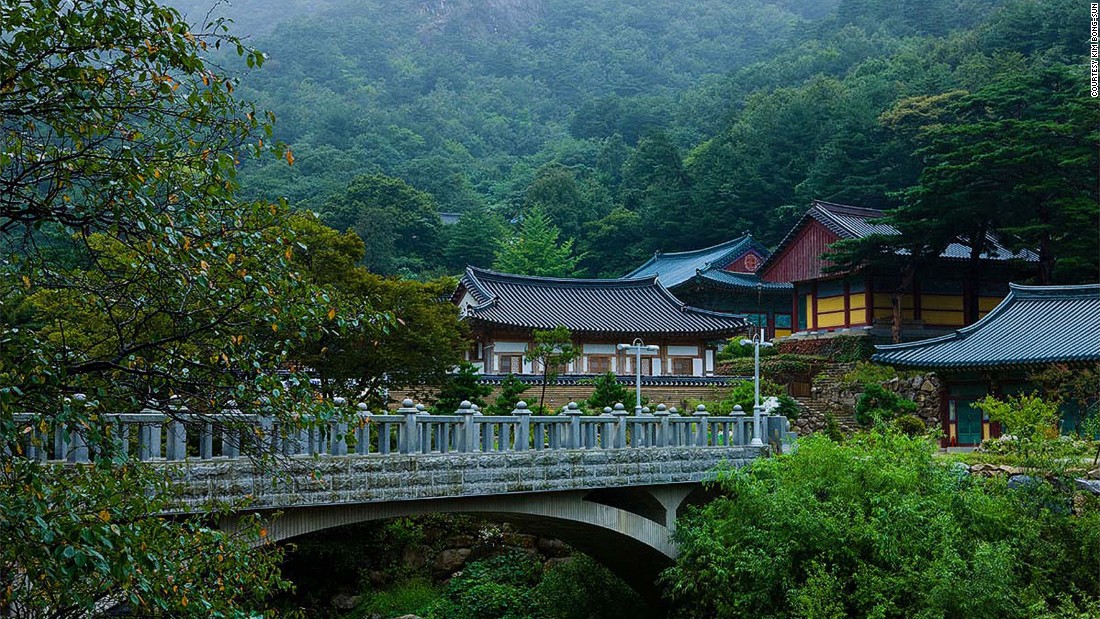
Final stop: South Korea

Now South
Korea is the largest market for plastic surgery per capita in the world. It is
estimated between 1/5 and 1/3 of the women in Seoul have gone under the knife
for at least one cosmetic procedure. This is astounding as there have been
reports of Chinese and Japanese women that have been so changed by their
surgical procedures that airlines have trouble knowing if it’s really them,
because they look nothing a like with their passport photo.
Now that
you know what an amazing country we will be in let’s take a ride into the
unknown and discover our last stop…
HISTORY
 Now as we’ve
done in all our previous travels, you know the drill, you can’t possibly try to
understand a country without knowing its background, now s we all have heard
during one point or another, Korea wasn’t always as divided as it is now, part
of the culture shock visitors might present can be with the way of development
in human interactions with Korean people. That’s why it is important (as we’ve
already seen) to know our background.
Now as we’ve
done in all our previous travels, you know the drill, you can’t possibly try to
understand a country without knowing its background, now s we all have heard
during one point or another, Korea wasn’t always as divided as it is now, part
of the culture shock visitors might present can be with the way of development
in human interactions with Korean people. That’s why it is important (as we’ve
already seen) to know our background.
So as
always please hang on tight, because we are about to engage in a time
travelling experience to learn more about South Korea… !!
 According
to myths, Korea was formed in 2333 BC by the god-king Tangun. Archaeological
evidence, however, shows signs of life on the Korean Peninsula 700,000 years
ago. It has existed either independently or as a collection of states for
thousands of years and has experienced many invasions from neighbouring
countries. Many of these were repelled despite considerable internal turmoil.
Historically, the country has not welcomed foreign influence. It was a single
independent country from the seventh century, when it was formed from three
states, until the 20th century. The Russo-Japanese war resulted in the country
becoming a protectorate of Japan in 1905 before being annexed as a colony in
1910. The following years of colonial rule were a time of growing resentment as
Japan tried to suppress the Korean language and culture.
According
to myths, Korea was formed in 2333 BC by the god-king Tangun. Archaeological
evidence, however, shows signs of life on the Korean Peninsula 700,000 years
ago. It has existed either independently or as a collection of states for
thousands of years and has experienced many invasions from neighbouring
countries. Many of these were repelled despite considerable internal turmoil.
Historically, the country has not welcomed foreign influence. It was a single
independent country from the seventh century, when it was formed from three
states, until the 20th century. The Russo-Japanese war resulted in the country
becoming a protectorate of Japan in 1905 before being annexed as a colony in
1910. The following years of colonial rule were a time of growing resentment as
Japan tried to suppress the Korean language and culture.
Independence
was regained at the end of World War Two when Japan surrendered to the United
States in 1945. The Republic of Korea (ROK) was formed in the southern half of
the Korean Peninsula on 15 August 1948. In the north of the peninsula a
Communist style government was formed in September of the same year: the
Democratic People's Republic of Korea (DPRK).
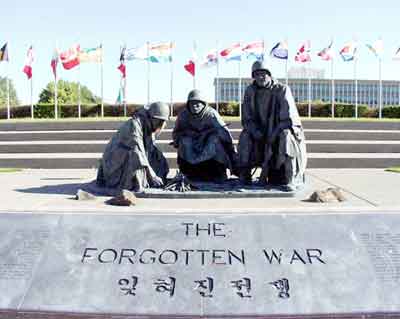
The Korean
War broke out when northern troops invaded South Korea in June 1950. They were
backed by China and the Soviet Union. Troops from the United Nations and the
United States fought with soldiers from the southern Republic of Korea to
defend it from the Communist north. In 1953 an armistice was signed by the
Korean People's Army, the Chinese People's volunteers, and the United
States-led United Nations Command, splitting the peninsula along a
demilitarised zone. The war resulted in over three million Koreans being
injured or killed and countless families separated by the divide along the 38th
parallel.
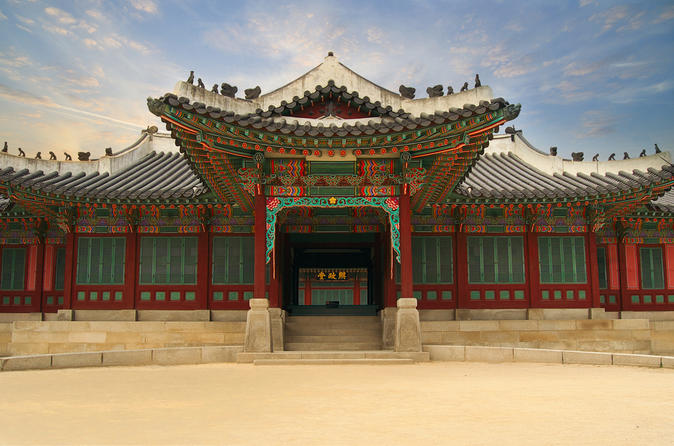 With help
from economic aid from the United States, South Korea subsequently experienced
rapid economic growth while the north remained economically and politically
isolated from the rest of the world. The decades following the war were
politically turbulent with autocratic leaders and strong protests by students
and labour union activists against authoritarian rule.
With help
from economic aid from the United States, South Korea subsequently experienced
rapid economic growth while the north remained economically and politically
isolated from the rest of the world. The decades following the war were
politically turbulent with autocratic leaders and strong protests by students
and labour union activists against authoritarian rule.
After 32
years of military rule Kim Young-sam became the first civilian president of
South Korea in 1993. In 1997 Kim Dae-jung was elected from a major opposition
party. He had been a life-long human rights and democracy activist and his
election marked a huge step forwards in the country's democracy. He won the
Nobel Peace Prize in 2000 for his Sunshine Policy regarding North Korea. A
family reunification programme was started in 1985 and continues to this day.
Serious tensions remain with North Korea which is highlighted by the sinking of
the warship Cheonan by North Korea in 2010 and the artillery attack on South
Korean soldiers and civilians later in the same year.
POLITICS
AND ECONOMY
 Something I
did not include in our previous travels was this section, since I thought the historical
context would be more than enough to give you a background of the actual
context, now I will probably add in that part later I am not sure but the
reason I am including this section here is because I find a lot of
misunderstandings and concerns following the South Korean government, with the
hope of trying to dissipate some of these misconceptions or doubts I decided it
would be a good idea to include this section.
Something I
did not include in our previous travels was this section, since I thought the historical
context would be more than enough to give you a background of the actual
context, now I will probably add in that part later I am not sure but the
reason I am including this section here is because I find a lot of
misunderstandings and concerns following the South Korean government, with the
hope of trying to dissipate some of these misconceptions or doubts I decided it
would be a good idea to include this section.
Starting on
with the politics we can say South Korea is a republic whose president is the
head of state and whose prime minister is the head of government. It is a
multi-party system. The president is elected for a single five-year term in
office by popular vote. The prime minister is appointed by the president with
the consent of the National Assembly. The National Assembly (Kukhoe) is made up
of 299 seats; 245 are decided in single seat constituencies, the rest being
elected by proportional representation. Members serve a four-year term.
Legislative power is shared by the government and the National Assembly. A
State Council is appointed by the president after recommendation by the prime
minister.
 The country
is divided into nine provinces and seven cities which are administratively
separate: Seoul, Busan, Daegu, Incheon, Ulsan, Daejeon and Gwangju. The legal
system in South Korea is a mixture of European civil law, Anglo-American law
and classical Chinese thought. A Supreme Court is run by justices appointed by
the president with the consent of the National Assembly. South Korea joined the
United Nations in 1991, as did North Korea.
The country
is divided into nine provinces and seven cities which are administratively
separate: Seoul, Busan, Daegu, Incheon, Ulsan, Daejeon and Gwangju. The legal
system in South Korea is a mixture of European civil law, Anglo-American law
and classical Chinese thought. A Supreme Court is run by justices appointed by
the president with the consent of the National Assembly. South Korea joined the
United Nations in 1991, as did North Korea.
Now as for
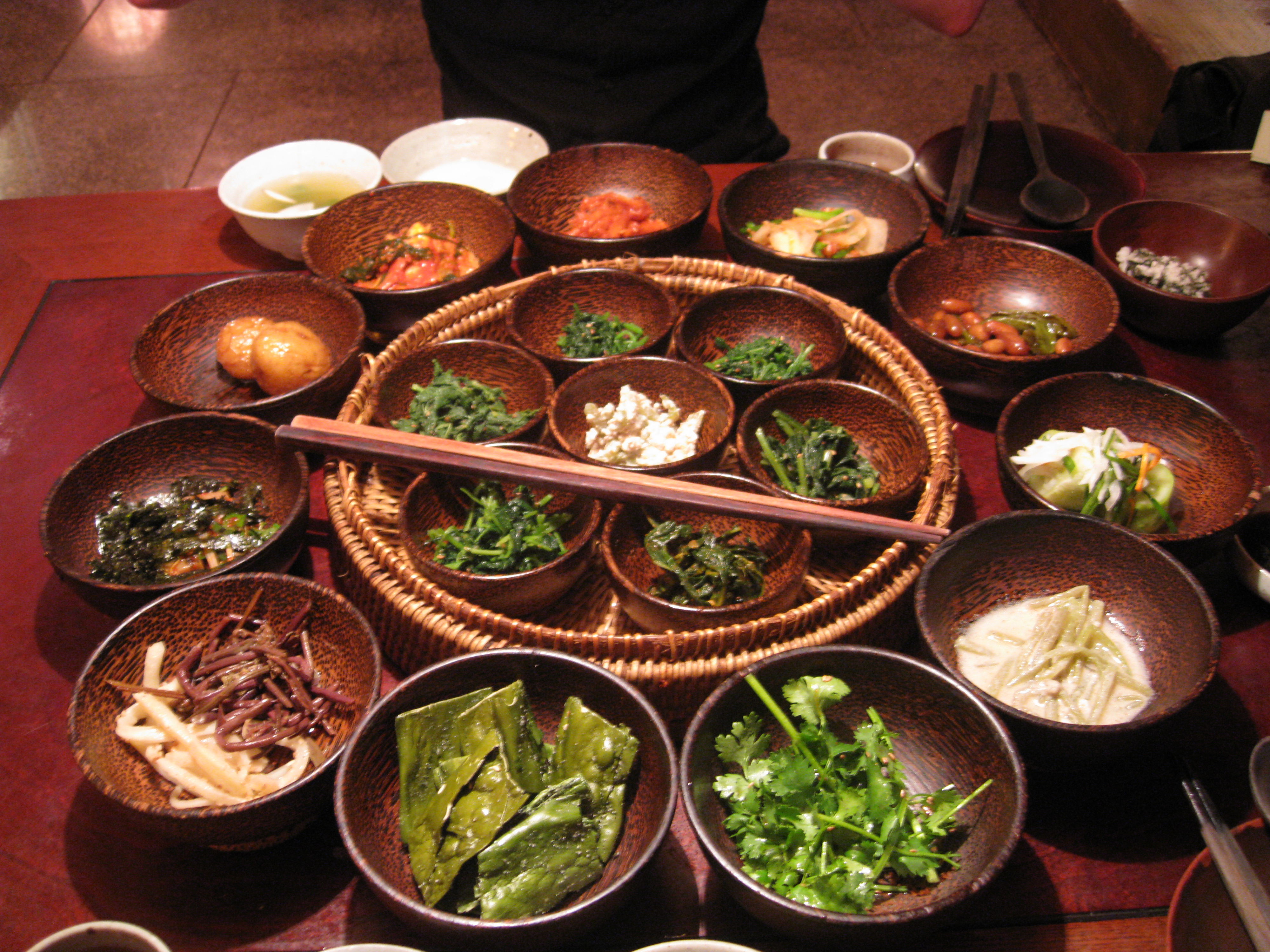
the economy we can travel back in time and remote to when South Korea
traditionally had an agricultural economy, which shifted towards manufacturing,
and with service industries becoming increasingly important. It has a state-led
market economy which has grown since the Korean War. The country benefited from
economic aid from the United States following the war. It has developed from
being one of the world's poorest countries to become one of the world's top 20
economies today.
 FOOD
FOOD
So far we have
done our go to historical review, plus the politic and economical state of the
country, we will now move on to one of our favorite topics here… you guessed it…
FOOD.
For
centuries, the Koreans have eaten the products of the land and sea. They began growing
grains thousands of years ago, and rice cultivation was introduced to some
parts of the country around 2000 b.c. During this time they also grew millet (a
type of grass grown for its edible seed), soybeans, red beans, and other
grains. They cured and pickled fish, were skilled in making wine and bean
paste, and often used honey and oil in cooking.
Chinese and
Japanese invasions during the fourteenth through twentieth centuries gave rise
to a culinary influence on Korea that remains today. Like the Chinese and
Japanese, Koreans eat rice with almost every meal and use chopsticks. Eating
with chopsticks means the food is usually cut up into little pieces that are
easy to pick up. Food cut this size cooks fast, which cuts down on the use of
fuel.
Unlike
China and Japan, however, Korea was never a tea-drinking nation. Historically,
China and Japan had to boil their water for it to be fit to drink. Korea's
water was pure, which led them to discover other beverages, such as ginseng and
ginger drinks (made from herbs of the same name), wines, and spirits. Soo
Chunkwa (ginger drink) is often served on joyous occasions during the winter,
and especially at New Year's.
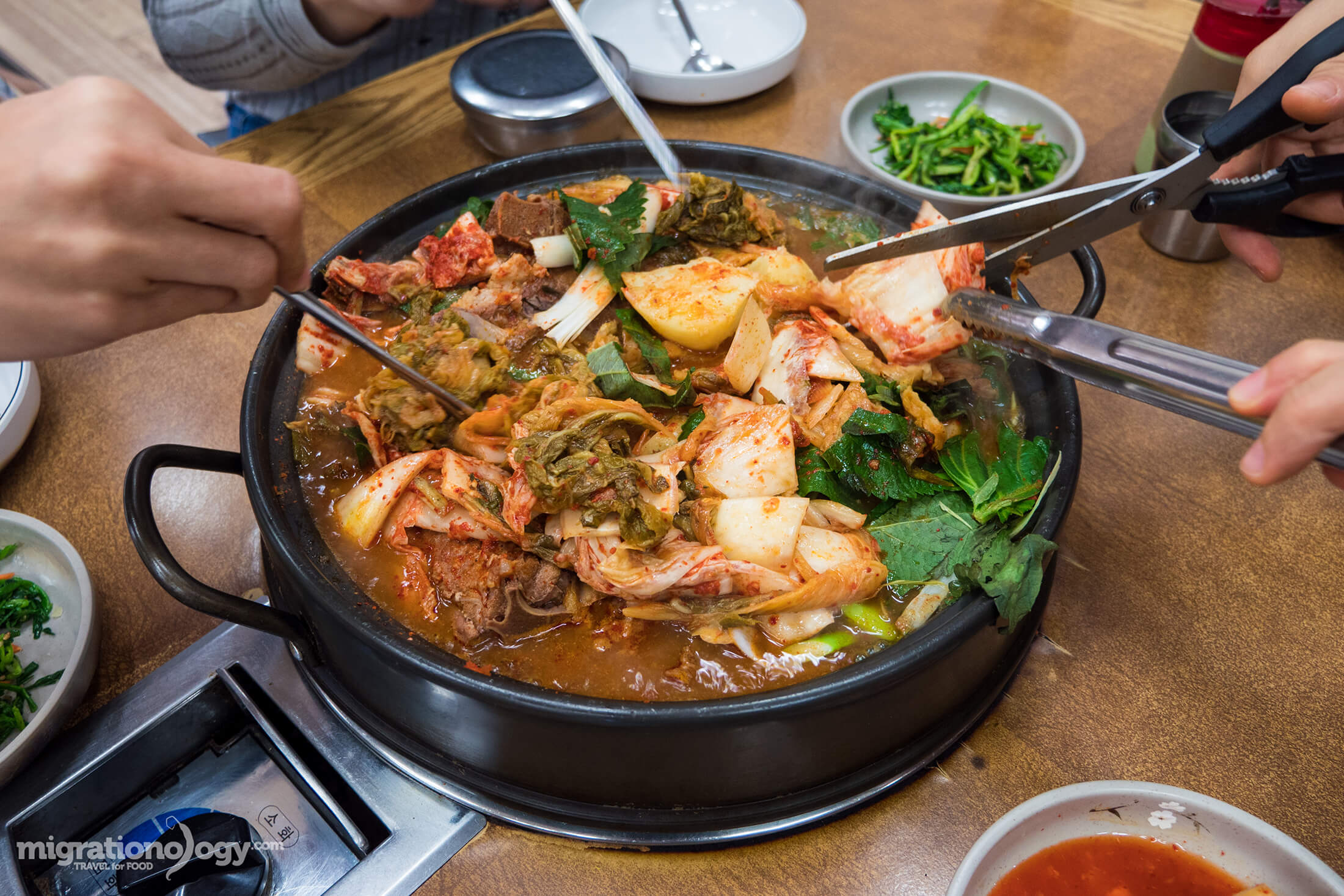
 Upon
visiting Korea, people are without a doubt impressed by the large number of
dishes and large volume of food served from theKorean course menu called
hanjonshik. While this is a characteristic of the Korean culture, the Japanese
point of view wonders, if there is too much food to be eaten, why not decrease
the quantity and lower the price? The extravagant Korean course menu adheres to
traditional convention by mustering rice, soup, kimchee, namuru (seasoned vegetables),chige(a
stewed dish),chimu(a steamed dish),kui(a grilled dish), pokkumu (a fried dish),
chorimu (a boiled dish), chon (a seared
Upon
visiting Korea, people are without a doubt impressed by the large number of
dishes and large volume of food served from theKorean course menu called
hanjonshik. While this is a characteristic of the Korean culture, the Japanese
point of view wonders, if there is too much food to be eaten, why not decrease
the quantity and lower the price? The extravagant Korean course menu adheres to
traditional convention by mustering rice, soup, kimchee, namuru (seasoned vegetables),chige(a
stewed dish),chimu(a steamed dish),kui(a grilled dish), pokkumu (a fried dish),
chorimu (a boiled dish), chon (a seared
dish), fe
(sashimi or raw fish), chokkaru (a salty dish), and more for course meals. The
highlight is a large number of trays with a variety of dishes presented. So
many dishes are presented that it seems that the legs of the table will break
with their weight and the food is rarely all eaten, but the pure lavishness of
it all is truly impressive.
One thing
that we should all keep in mind is that, even if the countries we have visited
so far are in Asia and in some points are very much alike, it is very important
to notice that there IS a difference when it comes to types of food, traditions
and much more.
 ARTS
ARTS
Let us now
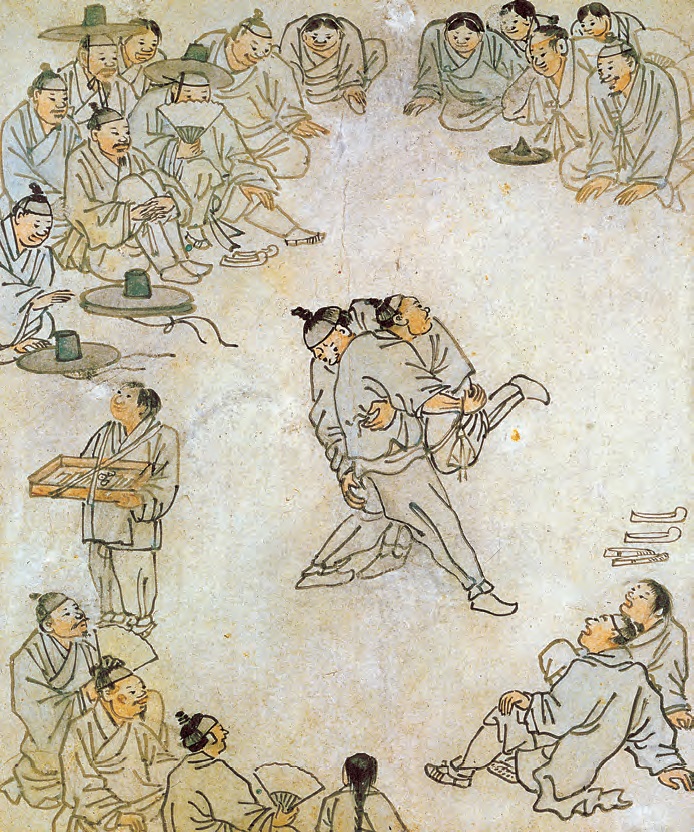
dive into the fascinating world of arts traditionally, Korean art has borrowed
heavily from the aesthetics of both Chinese art and Japanese art, using similar
concepts, motifs, techniques, and forms. But despite this close association
with the characteristics of traditional Chinese art, Korean artists have over
the centuries developed a distinctive style of their own. The unique character
of Korean art lies in its understated simplicity and spontaneity, together with
a feeling of harmony with nature.
One of the
main characteristics of Korean art is its close association with naturalism, a
characteristic already noticable by the time of the Three Kingdoms period (c.57
BCE - 668 CE) but fully established by the Silla period (668–935). The practice
of accepting nature as it is, led to a highly developed appreciation for the
simple and the unadorned. In wood carving, for instance, Korean sculptors
favoured the unaltered beauty of the natural wood grain. In ceramic art, the
Korean potter was not interested in achieving technical perfection (in his
surfaces, curves, or shapes), but in bringing out the natural characteristics
of his materials and medium.
LANGUAGE
 Surprisingly
as it may be, if you have read my previous entries you will now know that in comparison
to Japanese and Chinese you will soon find out that the Korean language is very simple, and can be similar in
structure to ours, for you to get a better idea, I will explain it.
Surprisingly
as it may be, if you have read my previous entries you will now know that in comparison
to Japanese and Chinese you will soon find out that the Korean language is very simple, and can be similar in
structure to ours, for you to get a better idea, I will explain it.
As expected
Koreans speak Korean, and if you can learn a handful of words ahead of
travelling it will be very helpful to you. The Koreans consider themselves to
be one family and they speak one language. They have a strong cultural
identity. The Korean language is spoken by 65 million people living in or near
to South Korea. Elsewhere in the world 5.5 million people speak Korean.
The
language is very different to any Western language in terms of the grammar and
the pronunciation. Whereabouts you are in South Korea will determine the
dialect spoken. The Seoul dialect, is understood and spoken by almost everyone.
Notably amongst the other dialects, the Gyeongsang dialect which is spoken
around Busan and Daegu is considered to sound aggressive compared to standard
Korean, and the Jeju dialect spoken on Jeju island is known for being almost
incomprehensible to speakers of standard Korean, however the pure Jeju dialect
is becoming less and less common.
 The way
Koreans write is surprisingly easy to learn and understand. It is a unique
phonetic writing system called hangul.
The way
Koreans write is surprisingly easy to learn and understand. It is a unique
phonetic writing system called hangul.
The writing
system uses sounds, stacked into blocks that represent syllables.
The system
was designed by a committee it looks when you first glance at it like it is
predominantly right angles and small circles. It is very logical and so you may
find you can start to recognise elements.
Many Korean
words can also be written with more complicated Chinese characters, known as
hanja in Korean. These are still occasionally mixed into text but are becoming
less common. These days, hanja are mainly used for making words less ambiguous
- if the meaning is ambiguous when written in hangul. Hanja are also used to
mark newspaper headlines, Korean chess pieces, as well as personal names on
official documents.
RELIGION
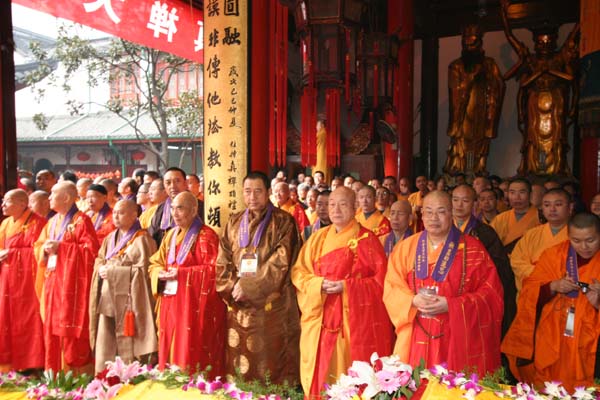
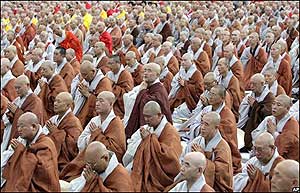 Now as we’ve
understood or at least we now have a brief glimpse of what the Korean language and
culture involves we can be bothered to learn about the religion, s you may have
thought at the beginning of our journey that there was one religion for all
Asia, we have learned so far that the roots (as in the majority of things) are
the same, but later on as they develop they can take different turns,
directions or meanings, Koreans, like other East Asians, have traditionally
been eclectic rather than exclusive in their religious commitments. Their
religious outlook has not been conditioned by a single, exclusive faith but by
a combination of indigenous beliefs and creeds imported into Korea. Belief in a
world inhabited by spirits is probably the oldest form of Korean religious
life, dating back to prehistoric times. There is a rather unorganized pantheon
of literally millions of gods, spirits, and ghosts, ranging from the "god
generals" who rule the different quarters of heaven to mountain spirits
(sansin). This pantheon also includes gods who inhabit trees, sacred caves, and
piles of stones, as well as earth spirits, the tutelary gods of households and
villages, mischievous goblins, and the ghosts of persons who in many cases met
violent or tragic ends. These spirits are said to have the power to influence
or to change the fortunes of living men and women.
Now as we’ve
understood or at least we now have a brief glimpse of what the Korean language and
culture involves we can be bothered to learn about the religion, s you may have
thought at the beginning of our journey that there was one religion for all
Asia, we have learned so far that the roots (as in the majority of things) are
the same, but later on as they develop they can take different turns,
directions or meanings, Koreans, like other East Asians, have traditionally
been eclectic rather than exclusive in their religious commitments. Their
religious outlook has not been conditioned by a single, exclusive faith but by
a combination of indigenous beliefs and creeds imported into Korea. Belief in a
world inhabited by spirits is probably the oldest form of Korean religious
life, dating back to prehistoric times. There is a rather unorganized pantheon
of literally millions of gods, spirits, and ghosts, ranging from the "god
generals" who rule the different quarters of heaven to mountain spirits
(sansin). This pantheon also includes gods who inhabit trees, sacred caves, and
piles of stones, as well as earth spirits, the tutelary gods of households and
villages, mischievous goblins, and the ghosts of persons who in many cases met
violent or tragic ends. These spirits are said to have the power to influence
or to change the fortunes of living men and women.
Korean
shamans are similar in many ways to those found in Siberia, Mongolia, and
Manchuria. They also resemble the yuta found on the Ryukyu Islands, in Okinawa
Prefecture, Japan. Cheju Island is also a center of shamanism. Shamans are
normally only women.
BEAUTY
Finally before
this marvelous adventure comes to an end, let’s take a quick trip into Korean
beauty, the complex, somewhat desired and in some people’s point of view,
polemic out take in the beauty industry. Taking the example of K-pop idols we can
sometimes think that they seem so flawless it can’t be real. But that’s how
high Korean beauty standards are.
 South Korea
is a hotbed of cosmetic innovations and trends, but it's also dealing with
extreme plastic surgery and expectations of beauty. You've already seen how
Chinese women are flocking to the nation to alter their appearance (to the
point that they are unrecognizable in their passport photos!) but thanks to
Korean-American woman Julianna Haahs, we're all getting a closer look at just
how problematic these high beauty standards are.
South Korea
is a hotbed of cosmetic innovations and trends, but it's also dealing with
extreme plastic surgery and expectations of beauty. You've already seen how
Chinese women are flocking to the nation to alter their appearance (to the
point that they are unrecognizable in their passport photos!) but thanks to
Korean-American woman Julianna Haahs, we're all getting a closer look at just
how problematic these high beauty standards are.
First,
let’s talk about the standard for female. This is probably the most detailed
standards. First thing that Koreans tend to observe is the size of someone’s
head aka proportion. For head size, the smaller is the better. Korean singer
Ivy is known for her small head and many people including celebrities envy
that. The ideal head: body ratio is 1:8 and it applies to both male and female.
Second
thing is the forehead. Full round forehead is considered more beautiful either
than the flat one or the one with a pronounced browbone.
 High
eyebrows means it has noticeable distance to the eyes, it’s prettier than the
one that is too close to them.
High
eyebrows means it has noticeable distance to the eyes, it’s prettier than the
one that is too close to them.
For eyelid
area, there are two things that we need to consider. First, the area itself.
The pretty one is the flat one, and in contrary, the sunken one is not pretty
because it makes people look older. The second thing is the lid. Of course you
are all aware that double eyelid is necessary for female to look beautiful in
Korea. But at the moment the half way double eyelid is more popular. It’s
basically double eyelid that start from the middle of the eyes. And don’t
forget about the eyes, they have to be big.
Lately, the
ideal shape of nose is the one that is medium high with round tip. High nose in
girl consider unnatural and even unattractive. For jaw, v shape is still
preferable eventhough it’s not as important as before. Someone with square even
round jaw still can be beautiful if she meets the other criteria above.

And last
but not least, beautiful girl is preferably to have fair skin. Pretty girl with
tanned skin is okay, but even better if she’s fair. Finally, in addition to
cuteness, aegyo sal is almost a must.
For male, the
standards are not as strict as female. If someone is handsome, then he is,
despite not having certain best feature. Let me give two example of male
celebrities that is well known to be handsome. They are Kim Soo Hyun and member
of Infinite, L. You will see that both of them has different forehead, eyes,
nose, and jaw line, but they are both very attractive.
 Kim Soo
Hyun has defined forehead, mono eyelid, quite-high nose with medium width,
inverted triangle jaw, and a little bit definition on his cheek. His eyes is
medium in size and he has a subtle aegyo sal.
Kim Soo
Hyun has defined forehead, mono eyelid, quite-high nose with medium width,
inverted triangle jaw, and a little bit definition on his cheek. His eyes is
medium in size and he has a subtle aegyo sal.
L has a
similar defined forehead only not as strong, he has a little bit double eyelid,
higher and slimmer nose, oval jaw line, and softer cheekbone. Same with Kim Soo
Hyun, Infinite L also has medium size eyes and aegyo sal. So, now you can see
that both faces are very different but they are known to be handsome in Korea.
But one
thing that is important for male is that they have to be tall to be attractive.
Both Kim Soo Hyun and Infinite L are exactly 180 cm tall. 170 cm pretty much
the superficial minimum standard for guy. It is amazing how beauty standards
can be so changed from one point of view to another.

Korea is a
wonderful place, filled with a variety of cultural facts and collisions with
both their beauty standards and society, with this I finally conclude my travel
blog throughout Asia, it is time to pack our bags and take the one way ticket to
our home town. I hope you’ve enjoyed this blog, and thank you so much for
reading. I once again clarify that I have no profit intentions with this blog, it
is originally made for the single purpose of informing people who are
interested in Asia and it is also my final English project.
Thank you
so much for reading, until the next trip, keep being adventurous and never back
down on your travelling dreams!






_cp_300x225.JPG)